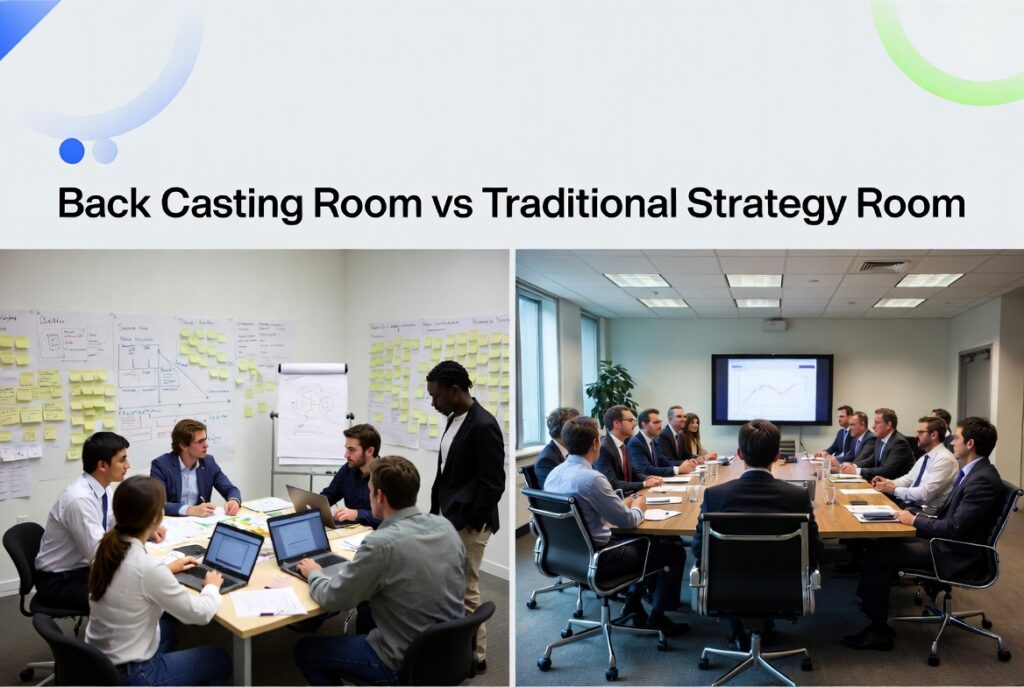
Many organizations are upgrading their meeting spaces, but there’s a big difference between a regular traditional strategy room and a purpose-built back casting room.
This detailed comparison will help you understand which setup will deliver better long-term results for your team.
Back Casting Room vs Traditional Strategy Room – Quick Overview
| Aspect | Back Casting Room | Traditional Strategy Room | Winner |
|---|---|---|---|
| Primary Purpose | Long-term visionary planning | Short to medium-term operational planning | Back Casting Room |
| Planning Approach | Backcasting (Future → Present) | Forecasting (Present → Future) | Back Casting Room |
| Time Horizon | 10–30+ years | 1–5 years | Back Casting Room |
| Room Design | Creative, flexible, visual-heavy | Formal, presentation-focused | Back Casting Room |
| Tools & Technology | Heavy visual collaboration | Standard AV equipment | Back Casting Room |
| Team Mindset | Bold, innovative, transformative | Practical, incremental | Back Casting Room |
| Best For | Sustainability, innovation, disruption | Budgeting, quarterly reviews | Depends on Goal |
| Overall Effectiveness | Superior for ambitious goals | Better for day-to-day execution | Back Casting Room for strategy |
Detailed Comparison Breakdown
1. Planning Philosophy
- Traditional Strategy Room: Focuses on analyzing current data and forecasting what is likely to happen. It’s great for tactical decisions.
- Back Casting Room: Starts with a bold desired future and works backward. This encourages breakthrough thinking instead of incremental improvements.
Winner: Back Casting Room for long-term competitive advantage.
2. Room Design & Environment
Traditional Strategy Room:
- Large conference table
- Projector and screen
- Formal seating arrangement
- Often feels corporate and rigid
Back Casting Room:
- Movable furniture for different activities
- Floor-to-ceiling writable walls
- Open space for movement and group exercises
- Inspirational visuals and flexible zones
The physical environment in a back casting room significantly boosts creativity and collaboration.
3. Tools and Technology Used
Back Casting Room typically includes:
- Multiple whiteboards and glass walls
- Digital collaboration platforms (Miro, Mural)
- Timeline mapping tools
- Sticky note systems and vision canvases
- Recording systems to capture sessions
Traditional rooms usually rely on PowerPoint presentations and basic video calls.
4. Outcomes and Results
Organizations using dedicated back casting rooms report:
- More innovative strategies
- Better alignment across departments
- Higher employee engagement in planning
- Faster progress toward ambitious goals (e.g., sustainability targets)
Traditional strategy rooms tend to produce safer, more conservative plans.
When to Use Each Type of Room
Use a Back Casting Room when you want to:
- Set 10–30 year vision
- Solve complex “wicked problems”
- Drive organizational transformation
- Work on sustainability or innovation initiatives
Use a Traditional Strategy Room when you want to:
- Do annual budgeting
- Review quarterly performance
- Make short-term operational decisions
- Run standard team meetings
Hybrid Approach (Recommended in 2026)
The smartest organizations don’t choose one or the other. They maintain:
- A Back Casting Room for visionary quarterly or bi-annual sessions
- Traditional strategy rooms for regular operational meetings
This combination gives the best of both worlds.
Real-World Examples
- IKEA used backcasting methodology in dedicated spaces to become a sustainability leader.
- Many tech companies have transformed traditional boardrooms into modern back casting rooms to stay ahead in innovation.
- Cities and governments are building “Future Rooms” or back casting rooms for urban planning.
How to Convert Your Existing Strategy Room into a Back Casting Room
- Add writable surfaces (whiteboards or IdeaPaint)
- Replace fixed furniture with modular pieces
- Install large digital displays
- Create a dedicated “Backcasting Kit” with materials
- Train facilitators on backcasting methodology
FAQ: Back Casting Room vs Traditional Strategy Room
What is the main difference between a back casting room and a traditional strategy room? A back casting room is designed for future-back visionary planning, while traditional rooms focus on present-forward incremental planning.
Is a back casting room worth the investment? Yes, especially for organizations with ambitious long-term goals. The ROI comes from better strategic decisions.
Can one room serve both purposes? Yes. With flexible design, a single room can function as both, though dedicated spaces perform better.
Which is better for startups? Startups benefit greatly from back casting rooms as they need bold vision to compete with larger players.
How often should we use a back casting room? At least 4 times per year for major strategy updates.
Final Verdict: Which One Should You Choose?
Back Casting Room wins for any organization serious about long-term success, innovation, and transformation in 2026.
While traditional strategy rooms still have their place for operational planning, investing in a proper back casting room (physical or hybrid) gives you a powerful strategic advantage.
Recommendation: Start by upgrading one existing meeting room with backcasting elements. Run your first session and measure the difference in ideas and team energy.
The future belongs to organizations that don’t just predict it — they design it.