In 2026, America is home to approximately 24 million millionaires — more than any other country and nearly 40% of the world’s total. This represents roughly 8.8% of American adults, or about 1 in every 11–12 adults.
The surprising truth? The vast majority are self-made. According to multiple studies, including the Dave Ramsey National Study of Millionaires and Northwestern Mutual’s 2025 research, 79–89% did not inherit significant wealth. They built it through consistent, disciplined habits over 25–30 years.
This comprehensive guide reveals exactly how most people are becoming millionaires today — the common paths, daily habits, professions, and actionable strategies you can apply right now.
The Profile of the Average 2026 Millionaire
Most millionaires aren’t tech billionaires or trust fund babies. They’re everyday people who followed proven systems.
Key Statistics:
- Average age: 57 years old.
- Reached millionaire status around age 50 after ~28 years of effort.
- 79–89% received little to no inheritance.
- 95% own their home.
- 47% actively invest in stocks.
- Only 15% were ever senior executives (CEO/CFO level).
- Many earned average or mid-level incomes over their careers.
Top Professions (from Ramsey Study):
- Engineer
- Accountant/CPA
- Teacher
- Management
- Attorney
- Medical professionals (not always doctors)
Ordinary careers + extraordinary consistency = millionaire status.
Primary Ways Most People Build Millionaire Wealth
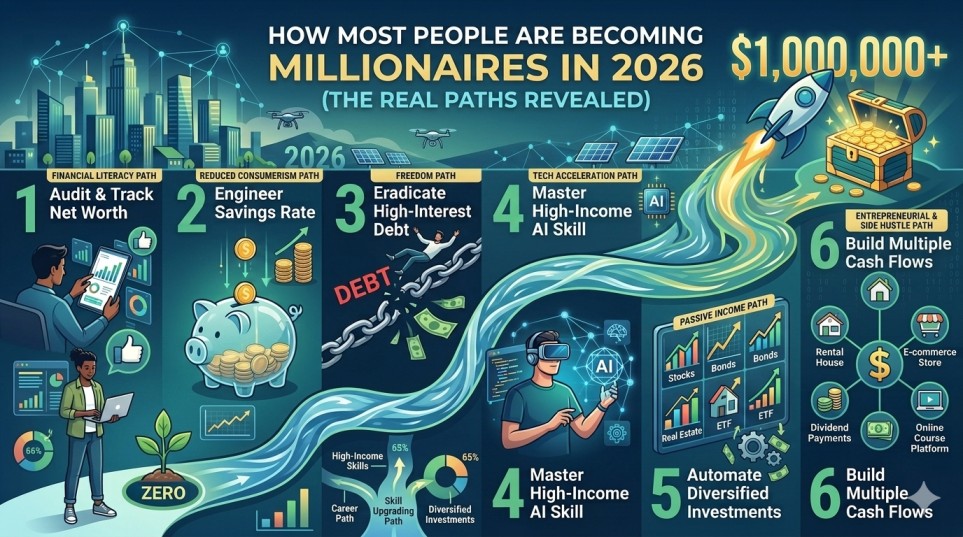
Here are the dominant paths backed by Federal Reserve, UBS, Ramsey, and Empower data:
1. Consistent Retirement Investing (The #1 Driver)
- 80%+ of millionaires credit their company 401(k) as a key factor.
- They maxed out contributions early, captured employer matches, and let compounding work for decades.
- Low-cost index funds (S&P 500, total market) delivered 7–10% average annual returns.
Why it works: Automatic payroll deductions remove emotion. Tax advantages boost growth.
2. Homeownership and Real Estate Appreciation
- 95% own homes, with significant equity built over time.
- Rising property values (especially post-2020) added hundreds of thousands to net worth.
- Many started with modest homes and used equity for further investments.
3. Living Below Their Means + High Savings Rates
- Saved 15–25%+ of income consistently.
- Avoided lifestyle inflation even as earnings grew.
- Minimal consumer debt; paid off mortgages aggressively.
4. Steady Career Growth and Income Increases
- Focused on reliable professions with good benefits.
- Took advantage of raises, promotions, and skill development.
- Many added side income through consulting, rentals, or small businesses.
5. Long-Term Stock Market Participation
- Patient investing through bull and bear markets.
- Avoided get-rich-quick schemes and day trading.
6. Entrepreneurship and Business Ownership (Accelerator Path)
- While not the majority, many built or scaled small businesses, often as a side activity.
How Millionaires Actually Built Their Wealth: Step-by-Step Breakdown
| Path Component | Contribution to Wealth | Most Common Practice |
|---|---|---|
| 401(k)/Retirement Accounts | 40–50%+ | Max contributions + employer match |
| Home Equity | 20–30% | Long-term ownership + mortgage paydown |
| Taxable Investments | 15–25% | Index funds, dollar-cost averaging |
| Business/Entrepreneurship | 10–20% | Side hustles scaling into main income |
| Other (Inheritance, etc.) | <20% | Minimal for most |
Daily and Yearly Habits of Self-Made Millionaires
- Budgeting: 64–93% actively track expenses.
- Pay Themselves First: Investments automated before discretionary spending.
- Debt Avoidance: No credit card balances; low or no car loans.
- Continuous Learning: Invest in education and skills.
- Monthly Reviews: Track net worth and adjust.
- Frugality: Buy used cars, clip coupons, meal prep — even at high incomes.
- Marriage and Dual Incomes: Strong partnerships common.
Real-World Examples of Everyday Millionaires
- The Teacher: Invested in 403(b) for 30 years, lived modestly, built home equity.
- The Engineer: Maxed 401(k), invested bonuses, bought rental property.
- The Accountant: Started side tax business, compounded retirement savings.
- The Government Worker: Steady pension + consistent TSP (Thrift Savings Plan) contributions.
These stories are repeated thousands of times across America.
Challenges and Realities in 2026
- Inflation: A million dollars buys less than before.
- Market Volatility: Requires staying invested long-term.
- Lifestyle Creep: The biggest threat as income rises.
- High Costs: Housing, healthcare, and education in major cities.
- Many “new” millionaires still work because they enjoy it or want more security.
Despite this, the path remains accessible.
How to Become a Millionaire Using the Proven Methods
You can replicate these strategies:
- Start Investing Today — Open a 401(k), IRA, or brokerage. Automate contributions.
- Live on Less Than You Earn — Track spending for 30 days and cut waste.
- Boost Your Income — Negotiate raises, learn high-value skills, start a side hustle.
- Buy a Home (When Ready) — Prioritize affordability and long-term holding.
- Diversify and Compound — Use index funds; rebalance annually.
- Protect Your Wealth — Build emergency fund, get insurance, plan estate.
- Stay Consistent — Focus on 20–30 year horizon.
Savings Needed to Reach $1M (at 8% return):
| Starting Age | Monthly Investment Needed |
|---|---|
| 25 | $500–$800 |
| 35 | $1,200–$1,500 |
| 45 | $2,500–$3,000 |
Myths vs. Reality About Becoming a Millionaire
- Myth: You need to inherit money. Reality: 79–89% did not.
- Myth: High-paying job required. Reality: Discipline beats salary.
- Myth: Overnight success. Reality: 25–30 years average.
- Myth: Risky investments. Reality: Boring, consistent index funds win.
- Myth: Too late after 40. Reality: Many succeed later with acceleration.
The Future of Millionaire Creation in America
With strong markets, real estate, 401(k) growth, and the Great Wealth Transfer (trillions moving from Baby Boomers), the number of millionaires is projected to keep rising toward 30+ million by 2030.
AI, remote work, and new industries create fresh opportunities, but the core formula remains the same: earn, save, invest, repeat.
Frequently Asked Questions (FAQ)
How are most millionaires made in 2026? Through consistent 401(k) investing, homeownership, living below their means, and long-term stock market participation over 25–30 years.
What percentage of millionaires are self-made? 79–89%, according to major studies.
Do you need a high salary to become a millionaire? No. Many teachers, engineers, and middle-income professionals achieve it through discipline.
What’s the #1 habit of millionaires? Automating investments (especially 401(k)s) and avoiding lifestyle inflation.
How long does it typically take? 28 years on average, reaching millionaire status around age 50.
Is homeownership necessary? Not strictly, but 95% of millionaires own homes and benefit from equity growth.
Can you still become a millionaire starting now? Yes. Starting late is better than never starting. Focus on income growth and high savings rates.
Conclusion: The American Millionaire Formula Still Works
In 2026, most people become millionaires the old-fashioned way: through decades of consistent earning, saving, investing, and smart asset building — not luck, inheritance, or viral fame.
The 24 million Americans who have achieved it prove the system works for those who commit. You don’t need to be extraordinary. You need to be consistent.
Start today:
- Calculate your current net worth.
- Set up automatic retirement contributions.
- Track your spending this month.
- Commit to one income-increasing action.
The path is clear, well-traveled, and available to anyone willing to follow it. Your millionaire future starts with the next smart decision.
The American Dream of earned wealth is alive and well — and more people are living it than ever before.
This article is for educational and informational purposes only. Individual results vary. Consult qualified financial advisors, accountants, and legal professionals for personalized advice. Data synthesized from UBS Global Wealth Report 2025, Dave Ramsey National Study of Millionaires, Federal Reserve, Northwestern Mutual, Empower, and other reputable 2025–2026 sources.