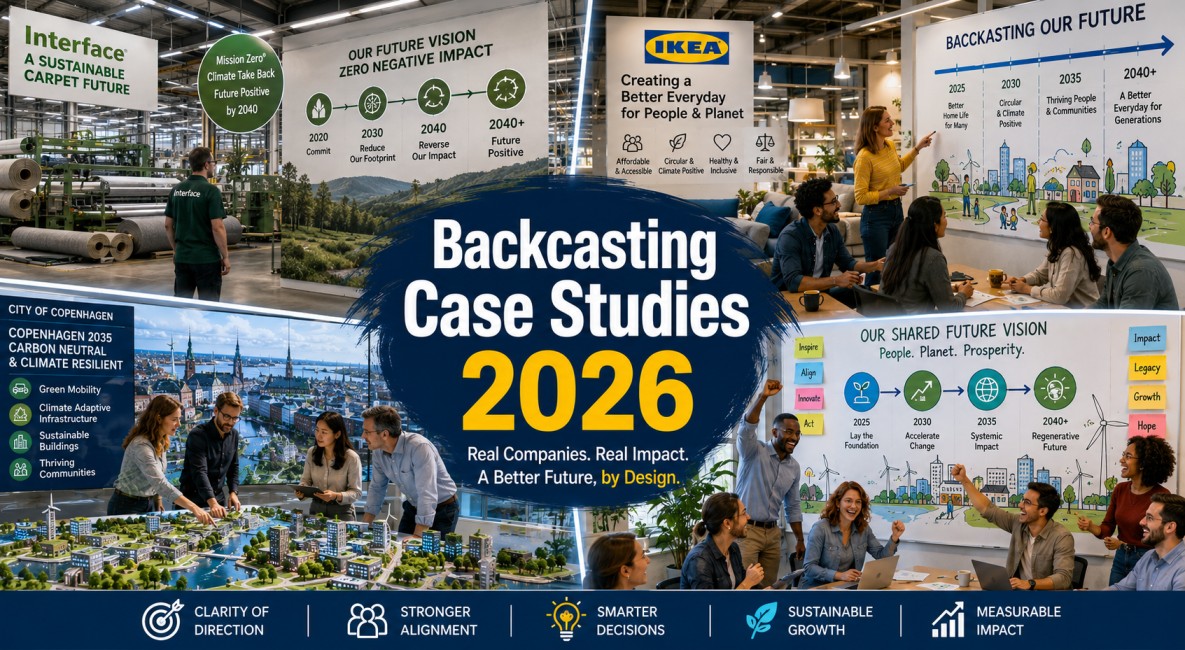
While the theory of backcasting sounds powerful, many leaders want proof it actually works. This comprehensive guide examines real-world backcasting case studies from leading companies, cities, and organizations in 2026.
You’ll discover what worked, what didn’t, and how you can adapt these successes in your own back casting room.
Why Backcasting Case Studies Matter
Backcasting has moved from niche sustainability tool to mainstream strategic methodology. Organizations using it properly are achieving ambitious goals faster than their competitors. These detailed case studies show exactly how they did it.
1. Interface Inc. – The Classic Backcasting Success Story (Updated 2026)
Background: Interface, a global carpet manufacturer, set the ambitious goal of becoming the world’s first fully sustainable company.
Backcasting Approach:
- They used “Mission Zero” — a vision of zero negative environmental impact by 2020 (later extended).
- Worked backward using The Natural Step framework in dedicated strategy rooms.
- Identified key levers: product redesign, renewable energy, closed-loop recycling, and culture change.
Results:
- Reduced greenhouse gas emissions by over 90%
- Achieved 100% renewable energy in many facilities
- Created innovative products like modular carpet tiles made from recycled fishing nets
- Significantly increased profitability while reducing environmental footprint
Key Lesson: Backcasting works best when paired with strong leadership commitment and cultural transformation.
2. IKEA – People & Planet Positive Strategy
Backcasting Vision: Become a fully circular and climate-positive business by 2030.
Implementation:
- Established multiple back casting rooms across global offices
- Defined success metrics across climate, materials, and social impact
- Worked backward to redesign supply chain, product lifecycle, and business model
Achievements by 2026:
- 80%+ of products designed for circularity
- Massive investment in renewable energy and reforestation
- Launched buy-back and resale programs successfully
- Maintained strong business growth while hitting aggressive sustainability targets
Lesson Learned: Backcasting is most effective when broken into clear, measurable milestones with regular review sessions in the back casting room.
3. The City of Amsterdam – Circular Economy Backcasting
Vision: Become fully circular by 2050.
Process:
- Built a dedicated municipal back casting room
- Involved citizens, businesses, and experts in participatory backcasting
- Mapped required policy changes, infrastructure, and behavioral shifts
Outcomes:
- Major progress in construction waste reduction
- New circular procurement policies
- Successful pilot programs in food systems and textiles
Key Takeaway: Multi-stakeholder backcasting in a well-designed room produces more robust and accepted strategies.
4. Microsoft – Carbon Negative Goal
Microsoft used backcasting to commit to becoming carbon negative by 2030. They mapped required technological breakthroughs, supply chain changes, and internal policy shifts.
Results: Significant investments in carbon removal technology, renewable energy, and sustainable data centers.
5. Small Business Case Study: A Regional Manufacturing Company
Even smaller organizations benefit. A mid-sized European manufacturer used backcasting to transition to sustainable packaging.
Outcome: Achieved 70% reduction in plastic use within 18 months while increasing margins.
Common Patterns Across Successful Backcasting Case Studies
- Strong Future Vision — All successful cases started with a bold, inspiring vision.
- Dedicated Space — Organizations with physical or hybrid back casting rooms achieved better results.
- Regular Reviews — Quarterly backcasting sessions prevented drift.
- Cross-Functional Teams — Including diverse voices led to better solutions.
- Hybrid Methodology — Combining backcasting with forecasting delivered the best outcomes.
Challenges & Failures in Backcasting (What to Avoid)
- Too Vague Vision → Leads to poor execution
- Lack of Follow-through → Many companies create great plans but fail at implementation
- Resistance to Change → Without proper change management, backcasting fails
- Overly Optimistic Assumptions → Must balance vision with realism
How to Apply These Lessons in Your Back Casting Room
Step-by-Step Framework Based on Real Success Stories:
- Vision Workshop (Half Day)
- Backward Mapping (Full Day)
- Gap & Barrier Analysis (Half Day)
- Action Planning & Ownership (Half Day)
- Implementation Roadmap (Ongoing)
Tools & Templates Used in Top Case Studies
- The Natural Step Backcasting Canvas
- Three Horizons Framework
- Participatory Visioning Templates
- Digital tools like Miro and Mural
Measuring Success: KPIs for Backcasting Initiatives
- Strategic Alignment Score
- Innovation Pipeline Strength
- Progress Toward Vision Metrics
- Employee Engagement in Strategy
- Sustainability/ESG Performance
Future Trends: Backcasting in 2026–2030
- AI-assisted backcasting tools
- Virtual reality back casting rooms
- Real-time collaborative platforms
- Greater integration with forecasting AI models
FAQ: Backcasting Case Studies
Which company has the best backcasting success story? Interface Inc. is still considered the gold standard, though IKEA’s scale is impressive.
Can small businesses successfully use backcasting? Yes. Many SMEs are achieving excellent results with simpler versions.
How long does it take to see results from backcasting? Initial benefits appear within months, but major transformation usually takes 3–10 years.
Is backcasting only for large corporations? No. It works across all organization sizes and sectors.
Final Verdict & Action Steps
The backcasting case studies of 2026 prove that organizations willing to invest in proper methodology and dedicated back casting rooms achieve superior long-term results.
Your Next Steps:
- Study one of the above case studies deeply
- Book your first backcasting session
- Design (or upgrade) your back casting room
- Commit to quarterly reviews
The difference between organizations that thrive and those that merely survive increasingly comes down to who can effectively design their desired future — not just predict it.
Backcasting gives you that power.