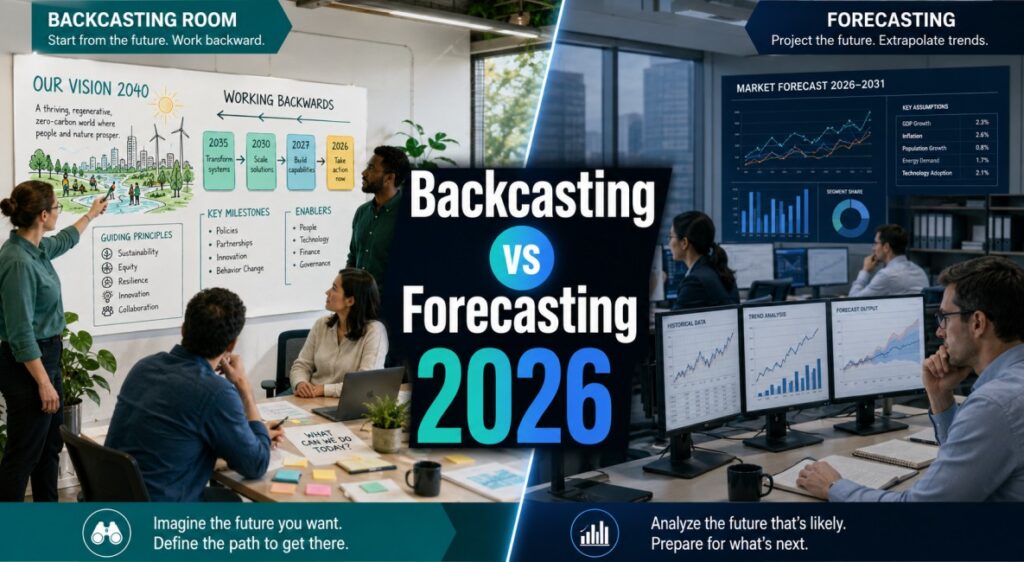
Business leaders and strategists often debate between backcasting and forecasting. Both are powerful planning tools, but they work in fundamentally different ways.
This detailed comparison will help you understand when to use each method and why many successful organizations now use both.
Backcasting vs Forecasting: Quick Summary
| Aspect | Backcasting | Forecasting | Winner |
|---|---|---|---|
| Core Approach | Start from desired future → Work backward | Start from present → Predict forward | Depends on Goal |
| Time Orientation | Future-first | Present-first | – |
| Mindset | Visionary & Transformative | Predictive & Analytical | Backcasting for innovation |
| Best Time Horizon | 10–30+ years | 1–5 years | Backcasting for long-term |
| Risk Attitude | Embraces uncertainty creatively | Tries to reduce uncertainty | Forecasting for operations |
| Best For | Sustainability, Innovation, Disruption | Budgeting, Operations, Sales Planning | Both |
| Popularity in 2026 | Rapidly Growing | Still Dominant | Forecasting (traditional) |
What Is Forecasting?
Forecasting is the traditional method of predicting future outcomes based on current trends, historical data, and statistical analysis. It answers the question: “What is most likely to happen if current conditions continue?”
Common techniques include trend analysis, regression models, market research, and economic indicators.
What Is Backcasting?
Backcasting starts with a clear, desirable future vision and works backward to identify the necessary steps, policies, and actions required to reach that future. It answers: “If we want to achieve this specific outcome, what do we need to do starting today?”
Key Differences Explained
1. Direction of Thinking
- Forecasting: Moves from Present → Future (extrapolation)
- Backcasting: Moves from Future → Present (prescriptive)
2. Purpose and Application
- Forecasting excels at operational decisions, risk assessment, and short-term planning.
- Backcasting is superior for setting ambitious goals, driving innovation, and solving complex problems like climate change or digital transformation.
3. Strengths and Weaknesses
Forecasting Strengths:
- Data-driven and measurable
- Good for budgeting and resource allocation
- Reduces immediate risks
Forecasting Weaknesses:
- Can trap organizations in “business as usual”
- Poor at handling disruptive change
- Often leads to incremental thinking
Backcasting Strengths:
- Encourages bold, creative solutions
- Breaks path dependency
- Motivates teams with inspiring vision
Backcasting Weaknesses:
- Can feel unrealistic without good execution
- Harder to quantify in early stages
- Requires strong facilitation
When to Use Backcasting vs Forecasting
Use Forecasting When:
- Creating annual budgets
- Sales and revenue projections
- Supply chain planning
- Short-term market analysis
Use Backcasting When:
- Setting sustainability targets (e.g., Net Zero 2040)
- Digital transformation initiatives
- Long-term innovation strategy
- Organizational vision development
Best Practice in 2026: Use a hybrid approach — apply backcasting for vision and strategy, then use forecasting to validate and execute the near-term steps.
Real-World Examples
- IKEA used backcasting to become a leader in circular economy and sustainability.
- Many tech companies use backcasting for 10-year technology roadmaps.
- Governments worldwide use backcasting for climate action plans (Paris Agreement alignment).
How to Combine Both Methods (Recommended Framework)
- Backcast first → Define the desired future and high-level pathway
- Forecast second → Test the feasibility of near-term actions
- Iterate regularly → Adjust based on new data
This combined method is considered best practice by many strategy experts in 2026.
FAQ: Backcasting vs Forecasting
What is the main difference between backcasting and forecasting? Backcasting starts from the future and works backward, while forecasting starts from the present and predicts forward.
Is backcasting better than forecasting? It depends on the goal. Backcasting is better for long-term transformation, while forecasting is better for short-term execution.
Can you use both backcasting and forecasting together? Yes. The most successful organizations use both in a hybrid model.
Which method is more popular in business? Forecasting is still more widely used, but backcasting is growing rapidly, especially in sustainability and innovation sectors.
What industries benefit most from backcasting? Energy, sustainability, technology, urban planning, and healthcare.
Final Verdict: Which Should You Choose?
Neither is universally better — they serve different purposes.
- Use Forecasting for tactical, data-driven decisions.
- Use Backcasting when you want to create breakthrough change and ambitious futures.
- Use Both for maximum strategic advantage in 2026.
Recommendation: Introduce backcasting into your strategy process this year. Start with one major long-term goal, run a backcasting session, then support it with solid forecasting for execution.
The organizations that thrive in uncertain times are those that master both — predicting what’s coming while actively designing the future they want.